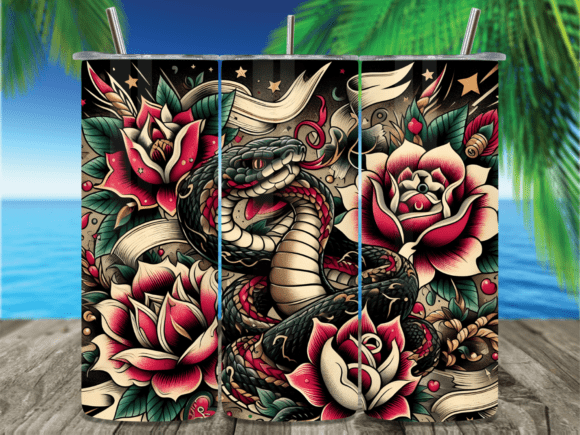
Traditional Tattoo Snake Tumbler Wrap
If you're designing custom drinkware for your small business, craft fair booth, or personal collection, the Traditional Tattoo Snake Tumbler Wrap is more than just bold imagery—it’s a functional, high-fidelity sublimation asset built for real-world use. Rooted in classic American tattoo iconography—think bold black outlines, rich shading, and symbolic serpentine motifs—this design delivers visual impact while meeting precise technical requirements for 20oz tumblers. But here’s what many buyers overlook: a striking image alone doesn’t guarantee great results. Success hinges on understanding file structure, resolution integrity, and usage boundaries—not just aesthetics.
Why This Design Fits Real Needs (Not Just Trends)
The Traditional Tattoo Snake Tumbler Wrap stands out because it bridges artistic tradition and production practicality. Unlike generic clipart or low-res downloads, this set includes two purpose-built PNG files: one straight (ideal for seamless wrap-around on cylindrical tumblers) and one tapered (optimized for contoured surfaces like skinny or wide-base tumblers). Both are sized at 9.3 × 8.2 inches (2790 × 2460 pixels) and rendered at 300 DPI—the industry standard for crisp sublimation transfers. That means no pixelation, no blurry edges, and no guessing whether your snake’s scales will hold up under heat press pressure.
It’s also licensed for commercial physical use: print it on tumblers, mugs, apparel, stickers, or tote bags without needing additional permissions. But—and this is critical—you’re not buying redistribution rights. You can’t resell the PNG file itself, share it in design bundles, or upload it to free graphic sites. That restriction protects both the creator’s work and your own brand integrity: using unlicensed or over-shared assets risks inconsistent quality, legal gray areas, and diluted market differentiation.
Common Missteps—and How to Avoid Them
Mistake #1: Assuming “high resolution” means “ready for any tumbler shape.”
Many designers download a beautiful 300 DPI file—then apply it to a 20oz Yeti-style tumbler only to find the snake’s head gets cut off or the tail stretches unnaturally. Why? Because not all 20oz tumblers have identical dimensions or curvature. A “straight” wrap works best on uniform cylinders (e.g., standard RTIC or simple stainless steel tumblers), while a “tapered” version compensates for subtle flares near the base or lip. Always measure your blank tumbler’s height and circumference first—and match that to the correct file variant. Don’t guess. Test with a mockup or print a paper wrap before committing to sublimation.
Mistake #2: Overlooking color mode and background transparency.
This download delivers clean, transparent-background PNGs—essential for sublimation, where white areas become part of the substrate color. But if you open the file in software that defaults to RGB with a white canvas (like older versions of Canva or some free editors), you might accidentally flatten the transparency or add unintended borders. Always verify transparency by opening the file in Preview (Mac) or Windows Photo Viewer—if you see a checkerboard pattern behind the snake, you’re good. If it’s solid white, you’ve likely lost the alpha channel. Use tools like Photoshop, Affinity Photo, or even free alternatives like Photopea to confirm and preserve transparency before sending to your printer.
Mistake #3: Skipping the DPI check before scaling.
Some users zoom in, crop, or resize the PNG in an editor—then wonder why lines look jagged after printing. At 300 DPI, the file is engineered to print sharply *at its native size*. Enlarging it beyond 100% in raster software degrades clarity; shrinking it unnecessarily sacrifices detail. If your tumbler requires slight adjustment, scale proportionally *within your RIP software* (like Sawgrass Virtuoso or MPress), not in a general-purpose image editor. That preserves vector-like fidelity during output.
What to Verify Before Downloading—or Printing
- File format: Confirm you’re receiving PNGs—not JPEGs (which lack transparency) or PDFs (which may embed fonts or vectors incompatible with sublimation RIPs).
- Dimensions & DPI: Double-check that both files are listed as 2790 × 2460 pixels at 300 DPI. Anything lower compromises edge definition, especially on fine linework like traditional tattoo shading.
- Licensing clarity: Look for explicit language about commercial physical use—and exclusions around digital redistribution. Vague terms like “for personal use” or “small business friendly” aren’t enough. This listing clearly states what’s permitted (tumblers, shirts, stickers) and prohibited (reselling the file).
- Download method: Instant digital delivery means no shipping delays—but also no customer service buffer if something goes wrong. Ensure your email accepts large attachments (some providers block files >25MB), and save backups immediately. Cloud storage or local folders beat relying solely on platform download links.
A Smarter Approach Starts With Intention
Choosing a Traditional Tattoo Snake Tumbler Wrap isn’t about chasing a trend—it’s about selecting a tool that supports your workflow, brand voice, and production standards. That means prioritizing technical accuracy over thumbnail appeal, verifying compatibility before purchase, and respecting licensing so your business stays scalable and ethical. It also means recognizing when a design serves your audience: tattoo enthusiasts respond to authenticity, not generic reptile graphics. This wrap leans into time-tested symbolism—protection, transformation, resilience—with execution that honors the craft.
So before you click “add to cart,” ask yourself: Does this file give me flexibility *and* precision? Does the seller clarify usage without legalese? Do I know how my specific tumbler model interacts with straight vs. tapered layouts? If yes—you’re not just buying a snake. You’re investing in consistency, credibility, and craftsmanship that shows up every time someone lifts that tumbler.