Laser Cut Wooden Box for Four Glass Set: Where Precision Craft Meets Functional Design
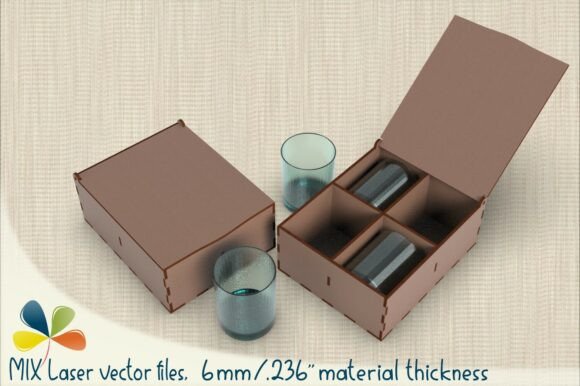
Imagine opening a drawer and finding not just four glasses—but four distinct personalities, each resting in its own thoughtfully proportioned chamber. The Laser Cut Wooden Box for Four Glass Set does more than hold glassware; it redefines how everyday objects inhabit space. This isn’t merely storage—it’s spatial choreography made tangible through 6 mm plywood, calibrated geometry, and digital craftsmanship.
Material Integrity as a Design Foundation
The choice of 6 mm (0.236 in) plywood is deliberate—not arbitrary thickness, but structural intention. Thicker stock resists warping under ambient humidity, maintains crisp edge definition after laser cutting, and absorbs impact without splintering—critical when handling delicate stemware or heavy-bottomed tumblers. Unlike thinner veneers that flex or dent under pressure, this density delivers tactile feedback: a quiet *thunk* when closing the lid, a reassuring heft in the hand, and long-term dimensional stability even with repeated use.
This material decision also enables clean kerf management. Laser cutting at this thickness yields consistent, burn-free edges with minimal charring—especially important where interior cells meet outer walls. The result? No sanding required for functional assembly, and no compromise on finish integrity if left raw, oiled, or painted. For educators demonstrating material science principles, or makers prototyping modular enclosures, the predictability of 6 mm plywood becomes a teaching tool in itself.
Geometry That Serves Both Form and Function
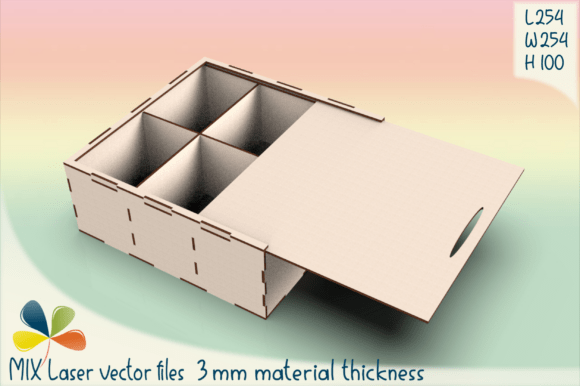
Outer dimensions—approximately 20 × 25 × 10 cm (7.8 × 10 × 3.9 in)—are not arbitrary either. They reflect ergonomic thresholds: wide enough to accommodate a standard wine glass base without crowding, deep enough to cradle a highball without tipping, and tall enough to allow vertical stacking while preserving airflow. Crucially, these outer measurements shift slightly depending on final material batch and laser calibration—a subtle reminder that precision manufacturing lives within real-world tolerances, not theoretical absolutes.
Inside, the fixed cell size—9.5 × 12 × 9.5 cm (3.7 × 4.7 × 3.7 in)—is where utility meets universality. Each cavity accommodates most common glass types: a Bordeaux glass (tall and tapered), a rocks glass (short and stout), a champagne flute (narrow and elongated), and a tumbler (cylindrical and versatile). The uniformity isn’t about rigidity—it’s about interoperability. A designer can swap out glassware based on occasion without redesigning the box. A researcher studying user interaction with tabletop objects can rely on repeatable spacing across test environments.
Note the symmetry: square footprint per cell, paired with vertical clearance exceeding typical glass height by 1.5–2 cm. That margin prevents accidental contact between rims and lid—a small detail with outsized impact on longevity and usability.
Design Files as Living Tools, Not Static Artifacts
The inclusion of both SVG and PDF formats transforms this from a product into a platform. SVG files retain vector scalability—ideal for adjusting kerf compensation in different laser software, nesting multiple units on a single sheet, or adapting cell depth for thicker-stemmed glasses. PDFs serve as universal reference: printable templates for manual routing, alignment guides for CNC jigs, or visual documentation for collaborative fabrication workshops.
In practice, this duality supports diverse workflows. A small-batch furniture maker might import the SVG into LightBurn to fine-tune power settings for their specific CO₂ laser. A university design lab could export the PDF to a vinyl cutter for cardboard mock-ups before committing to wood. A teacher building a STEAM unit on measurement tolerance might project the PDF onto a whiteboard and ask students to calculate volume displacement per cell—or estimate total material waste given standard plywood sheet sizes (e.g., 1220 × 2440 mm).
Real-World Applications Across Disciplines
The Laser Cut Wooden Box for Four Glass Set thrives where context shifts rapidly—and where objects must carry meaning beyond utility.
- Hospitality professionals use it to standardize bar setups across pop-up events: identical presentation for craft cocktail service, wine tastings, or non-alcoholic beverage stations—reducing setup time while elevating perceived quality.
- Educators in industrial design deploy it as a case study in constraint-driven innovation: How does fixed inner geometry influence outer form? What happens when you reduce wall thickness by 1 mm? Students prototype variations, then test load-bearing capacity or acoustic dampening properties.
- Hobbyists and woodworkers treat it as a gateway project—simple enough for first-time laser users, yet rich with learning opportunities: grain orientation effects on joint strength, finish absorption differences between face and edge grain, or how humidity swings affect plywood expansion in nested assemblies.
- Researchers in human factors apply it to studies on object affordance: Does consistent cell size improve retrieval speed? Does visible wood grain increase perceived value versus matte plastic alternatives? The box becomes data-generating infrastructure.
- Business owners launching curated home goods leverage its modularity—branding the lid, lining cells with custom-felt inserts, or bundling with regionally sourced glassware—to create cohesive, shelf-ready experiences without mass production overhead.
Durability Beyond the Obvious
“Solid and expressive box that gives your glasses a place of structure and charm” isn’t poetic flourish—it’s functional description. Structural durability manifests in three layers:
- Mechanical resilience: Interlocking finger joints (implied by laser-cut compatibility) distribute shear forces across multiple contact points—not reliant on glue alone. Repeated opening/closing doesn’t loosen fit over time.
- Environmental resilience: Plywood’s cross-laminated construction counters moisture-induced swelling better than solid wood. When finished with food-safe mineral oil or hard wax, it gains resistance to condensation rings—common near bar areas or kitchen countertops.
- Temporal resilience: Unlike injection-molded plastic that yellows or becomes brittle, well-maintained plywood ages gracefully—developing patina, not degradation. A box used daily for five years may show wear along lid edges, but the core geometry remains unchanged.
This layered durability makes it suitable for high-touch environments: a shared studio kitchen, a co-working lounge bar, or a traveling sommelier’s kit. It endures not because it’s indestructible—but because its failure modes are slow, visible, and repairable.
Integration Into Broader Creative Systems
What distinguishes this design from generic storage is its role as an anchor point—not an endpoint. Its proportions invite adjacency: stack two units vertically for eight-glass capacity, align three side-by-side for linear bar service, or rotate one 90° to create asymmetrical shelving rhythm. The fixed inner cell size means accessories scale accordingly—a 9.5 cm diameter cork coaster fits flush; a 12 cm tall napkin ring nests neatly beside the box.
For creators building systems rather than singular objects, the Laser Cut Wooden Box for Four Glass Set functions as a module in a larger grammar. Pair it with matching coasters cut from the same plywood batch. Use offcuts to laser-engrave glass markers. Repurpose scrap into drawer dividers for utensil organization. The design doesn’t isolate—it connects.
Thoughtful Constraints, Unconstrained Possibility
At first glance, the specifications seem restrictive: fixed inner dimensions, specific material thickness, defined file formats. Yet those constraints are precisely what enable reliability, reproducibility, and reinterpretation. In creative work—whether coding, carpentry, or curriculum design—constraints clarify intent. They answer unspoken questions: “How much space does a glass *need*?” “What thickness balances weight and strength?” “Which file format ensures fidelity across software ecosystems?”
That clarity lets users focus energy where it matters most—not troubleshooting fit issues, but considering how light falls across the grain when placed near a window, how the box feels alongside ceramic mugs and stainless steel shakers, or how its presence subtly cues guests toward intentional consumption. Structure, here, isn’t rigidity—it’s permission to attend closely to detail, relationship, and consequence.
When a design anchors creative flow, it does so quietly: holding space without demanding attention, supporting variation without enabling chaos, and enduring not despite use—but because of it. The Laser Cut Wooden Box for Four Glass Set achieves this by honoring material truth, respecting dimensional logic, and trusting users to find their own meaning within its measured boundaries.