Hearts: Stitch Joy into Every Project
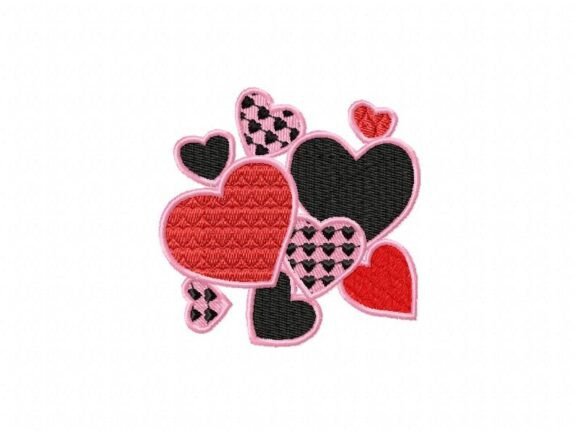
Hearts aren’t just symbols—they’re quiet storytellers in fabric. Whether stitched in soft pastel thread on a baby blanket or rendered in bold, saturated hues across a café apron, a heart design carries warmth, intention, and emotional resonance. The Colorful Heart Embroidery Design takes that universal shape and transforms it into something vibrantly contemporary: a tightly digitized, balanced, and joyful motif built for real-world use—not just display.
Why “Hearts” Matters—Beyond the Obvious
At its core, Hearts is a design category rooted in accessibility and emotional clarity. Unlike abstract motifs or intricate florals, hearts communicate instantly. That simplicity makes them unusually versatile—but how that versatility plays out depends entirely on who’s holding the hoop.
For a beginner embroiderer, Hearts offers low-risk confidence building. There’s no complex layering, minimal jump stitches to manage, and forgiving proportions—even if registration shifts slightly, the heart remains legible and charming. A first-time user might stitch it onto a cotton tote bag using basic stabilizer and standard 40-weight thread, learning tension and hooping without frustration.
For a small business owner selling handmade kitchen linens, Hearts isn’t just decorative—it’s a subtle branding anchor. Imagine that same colorful heart repeated along the hem of tea towels, scaled down on dishcloths, or subtly mirrored in corner embroidery on oven mitts. It becomes a consistent visual cue customers recognize across products—without needing a logo or text. Here, reliability across file formats (PES, DST, JEF, VP3, EXP) means one purchase works on both a Brother SE600 and a commercial Barudan machine—no re-digitizing, no delays.
A freelance textile designer might use Hearts as a modular element: rotating, layering, or combining it with monograms or seasonal motifs (think hearts nestled inside snowflakes for winter collections or woven through vine stems for spring). The clean vector-based digitization allows crisp scaling—up to 5 inches wide for a pillow front, or down to 1.2 inches for cuff detailing—without jagged edges or lost detail. Flexibility like that saves hours in custom adaptation.
What Different Users Actually Prioritize
Not everyone evaluates Hearts the same way—and that’s okay. What matters most shifts with context, goals, and constraints:
- Hobbyists often care most about ease of use and visual payoff. They want to open the file, load it, and see something cheerful emerge quickly—no troubleshooting. The Colorful Heart Embroidery Design delivers that with well-graded underlay, moderate stitch density, and clear color-separation notes.
- Educators teaching embroidery value teaching clarity and consistency. This design demonstrates clean satin borders, smooth fill transitions, and logical stop points—ideal for breaking down technique step-by-step in a workshop or video tutorial.
- Content creators and bloggers need photogenic results and shareable variety. The vivid palette (think tangerine, cobalt, lime, and magenta) pops against neutral fabrics—making flat-lays and social posts more engaging without heavy editing.
- Home decor professionals weigh long-term durability and fabric compatibility. Because this design avoids excessive density and uses stable satin and fill techniques, it holds up beautifully on medium-weight linen, terry cloth towels, and even light denim—no puckering or thread breakage after repeated washing.
Practical Use Cases Across Real Projects
Here’s how Hearts shows up where it counts—not as decoration, but as function with feeling:
- Nursery essentials: Stitched onto organic cotton burp cloths or crib sheet corners, the heart adds tenderness without overwhelming delicate prints. Its compact size fits naturally within existing patterns.
- Café or boutique staff apparel: Embroidered on left-chest placement of aprons or uniforms, it signals approachability—especially when paired with names or roles (“Sam • Barista”). The color variety lets teams coordinate without matching exactly.
- Classroom or therapy tools: Occupational therapists sometimes use embroidered heart-shaped fobs or wrist weights to support fine motor development. The consistent shape supports repetition; the color variation aids visual discrimination practice.
- Community-driven craft kits: DIY embroidery kits for teens or seniors include Hearts because it’s universally understood, quick to complete, and emotionally rewarding—reinforcing engagement without requiring advanced skill.
Does This Fit Your Next Step?
If you’re weighing whether the Colorful Heart Embroidery Design aligns with your current work—or curiosity—ask yourself a few grounded questions:
- Are you stitching for personal joy, not perfection? Then its forgiving structure and cheerful result are assets—not compromises.
- Do you need one design that works across multiple machines or team members? Its broad format support removes compatibility guesswork.
- Is your goal to add meaning without words? Hearts communicates care, celebration, or welcome in seconds—ideal for gifts, hospitality spaces, or inclusive branding.
- Are you building a repeatable product line? Its scalability and clean digitization mean it adapts cleanly to new sizes, fabrics, and contexts—no redesign needed.
It won’t replace a custom-drawn monogram for a luxury bridal line. It won’t mimic hand-stitched French knots for fine art textiles. But where warmth, clarity, and joyful utility matter—Hearts meets the moment, stitch after thoughtful stitch.
Whether you’re choosing your first embroidery file or adding to a library of trusted motifs, Hearts stands out not for complexity—but for how quietly, consistently, and brightly it belongs.