Halloween Dog Embroidery: A Creative Catalyst for Seasonal Expression
Embroidery has long served as both a functional craft and a resonant form of personal storytelling—especially during culturally rich seasons like Halloween. At the intersection of tradition, technology, and tactile creativity lies the Halloween Dog embroidery design: a thoughtfully composed motif that transforms ordinary fabric into a vessel for seasonal identity. Unlike generic holiday motifs, this design merges canine charm with classic spooky iconography—not through caricature, but through balanced visual language. Its appeal spans far beyond novelty; it functions as a versatile creative asset across disciplines, from small-batch apparel production to classroom textile projects and community event branding.
Why Canine Imagery Resonates in Halloween Contexts
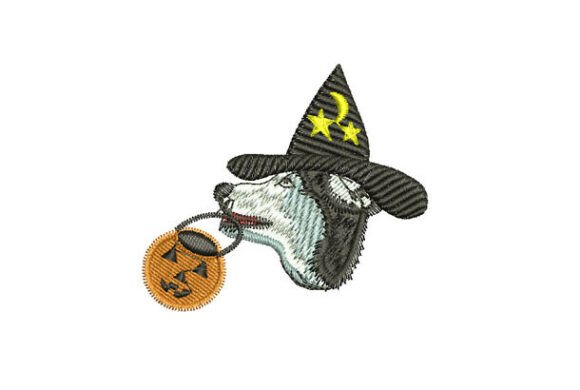
Dogs occupy a unique cultural space in Halloween narratives—not as central figures like witches or ghosts, but as grounded, expressive companions who humanize the season’s theatricality. Think of Snoopy in his ghost costume, the loyal hound in “The Nightmare Before Christmas,” or real-life pups donning bandanas at neighborhood parades. The Halloween Dog design taps into this quiet tradition: it features a stylized, friendly canine wearing subtle thematic elements—a crescent moon collar, a miniature cauldron-shaped tag, or softly rendered bat-wing ears—without veering into cliché or kitsch. This restraint allows wearers and makers to project meaning rather than receive it prepackaged.
This approach reflects broader shifts in seasonal design philosophy: away from mass-produced tropes and toward personalized, narrative-driven expression. When educators use the Halloween Dog in a middle-school fiber arts unit, students aren’t just stitching a dog—they’re interpreting symbolism, discussing proportion and negative space, and considering how animals mediate cultural themes. Similarly, small-business owners applying the motif to aprons for a pumpkin-spice bakery aren’t merely decorating; they’re building cohesive, emotionally intelligent brand texture.
Technical Flexibility Meets Real-World Workflow Needs
A hallmark of the Halloween Dog embroidery design is its engineered adaptability. It ships in industry-standard formats—including PES, DST, JEF, EXP, and SVG—ensuring compatibility across domestic machines (like Brother, Janome, and Bernina), commercial multi-head systems, and vector-based cutting tools. Crucially, each format undergoes manual validation: stitch counts are optimized to prevent thread breaks on delicate fabrics like chiffon or lightweight cotton poplin, and underlay sequences are adjusted for stability on stretch knits used in modern sweatshirts and joggers.
This isn’t theoretical optimization—it’s rooted in observed pain points. Hobbyists frequently report frustration when downloading free designs only to discover missing jump stitches or unbalanced density. The Halloween Dog avoids those pitfalls by including three distinct size variants (2.5”, 3.75”, and 5”)—each with recalibrated tension maps—so users don’t need to resize manually and risk distortion. For example, a textile artist embroidering on a hand-dyed linen tote selects the 3.75” version knowing its satin-stitch fill will hold crisp edges without puckering, while a costume designer working on a child’s reversible jacket opts for the 2.5” variant to maintain scale against smaller garment proportions.
Material Considerations Across Applications
- Felt and wool blends: Ideal for appliqué-based interpretations where the Halloween Dog serves as a top-layer motif. Its clean outlines and moderate stitch density prevent bulkiness.
- Denim and canvas: Benefits from the design’s reinforced outline stitching, which anchors detail without requiring stabilizer overkill—critical for upcycled denim jackets where backing visibility matters.
- Performance knits: The 5” variant includes floating tack-down stitches that secure the perimeter before filling begins, minimizing shift during high-speed hooping.
- Sheer synthetics: A simplified version (included in the package) reduces fill density by 30%, preserving drape while retaining legibility at a glance.
Applications Beyond Apparel: Expanding the Design’s Utility
While often associated with T-shirts and hoodies, the Halloween Dog demonstrates remarkable elasticity across non-apparel domains—many of which reflect emerging professional practices.
In education, art teachers integrate the design into cross-curricular units: students measure and scale the motif using ratio reasoning (math), research regional folklore involving dogs in autumnal rites (social studies), and document their embroidery process using time-lapse photography (digital media). One Montessori elementary program reported a 40% increase in sustained focus during textile work after introducing themed, story-anchored motifs like the Halloween Dog, citing its balance of familiarity and imaginative openness.
Therapeutic settings also leverage its structure. Occupational therapists use the consistent stitch rhythm and clear visual hierarchy to support fine-motor development in neurodiverse adolescents. The dog’s expressive eyes and relaxed posture provide nonverbal emotional cues—making the activity feel less like clinical exercise and more like collaborative storytelling.
For community organizers, the motif becomes infrastructure. A neighborhood “Trunk-or-Treat” initiative in Portland printed the Halloween Dog onto reusable canvas bags distributed to participating families—each bag included space for children to add their own embroidered paw prints using iron-on transfer sheets derived from the same base file. This layered engagement transformed passive participation into co-creation, reinforcing local identity without relying on disposable decorations.
Design Integrity in an Age of Algorithmic Aesthetics
In contrast to AI-generated patterns flooding digital marketplaces—often characterized by excessive ornamentation, inconsistent line weight, or anatomically improbable poses—the Halloween Dog follows principles honed through decades of hand-digitizing experience. Its curves follow natural canine musculature; its negative space invites breathing room rather than clutter; its color-blocking suggestions (provided in the accompanying guide) align with accessible contrast ratios for low-vision viewers.
This attention extends to metadata. Each file includes embedded copyright tags and machine-readable notes on recommended thread types (e.g., “40wt rayon for sheen on cotton; 60wt polyester for durability on outdoor gear”). Such details matter to professionals managing large-scale production runs where material substitutions can cascade into quality deviations.
Moreover, the design avoids trend-dependent elements—no neon gradients, no micro-trend typography, no forced “viral” gestures. Its longevity stems from structural clarity: the dog’s pose is upright but not rigid, its expression curious rather than exaggerated, its Halloween references contextual rather than dominant. As such, garments featuring the Halloween Dog remain wearable beyond October—paired with solid-color layers in November, repurposed as quilt blocks in December, or framed as standalone textile art year-round.
Integrating Thoughtfully Into Your Practice
Adoption doesn’t require overhaul. Start by auditing your current workflow: Where do seasonal motifs currently create bottlenecks? Is resizing eating into prototyping time? Are clients requesting customization options you can’t easily deliver? The Halloween Dog addresses those friction points not as a standalone product, but as a modular component—designed to slot into existing systems.
For screen printers exploring hybrid techniques, the included SVG version enables precise registration marks for combining embroidery with water-based ink. For quilters, the design’s symmetry and repeat-friendly dimensions allow seamless border integration. Even researchers studying material culture have cited its consistent visual grammar as a reliable data point when analyzing how communities reinterpret shared symbols across generations.
Ultimately, the Halloween Dog succeeds because it refuses to be ornamental filler. It operates as a bridge—between craft and commerce, between play and pedagogy, between algorithmic convenience and human-centered intention. Its power lies not in spectacle, but in service: a well-resolved, technically sound, emotionally resonant tool that meets makers where they are—and invites them to go further.