Fall Bow Pumpkin Autumn
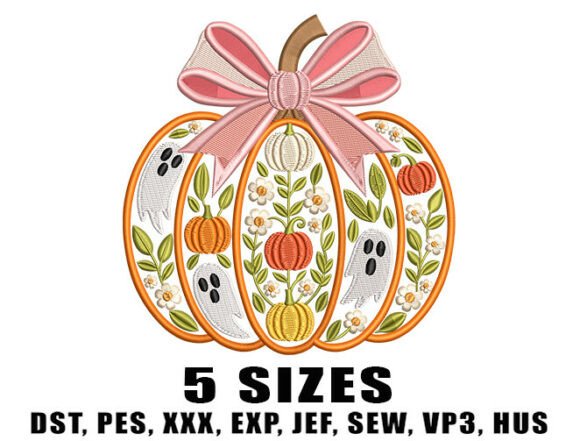
The Fall Bow Pumpkin Autumn embroidery design is more than seasonal decoration—it’s a precision-crafted digital asset with strategic versatility for creators, small business owners, and makers who prioritize intentionality over impulse. At its core, it’s a scalable, machine-ready motif that merges autumnal warmth with refined visual balance: a stylized pumpkin adorned with a soft, dimensional bow—neither overly rustic nor excessively polished, but calibrated for resonance across multiple touchpoints.
Why This Design Fits Real-World Planning Cycles
Seasonal product development isn’t about chasing trends—it’s about aligning production capacity, customer expectations, and inventory rhythm. The Fall Bow Pumpkin Autumn design supports that alignment because it’s offered in five precise sizes (3.8", 4.8", 5.8", 6.8", and 7.8") and 10 industry-standard formats (DGT, DST, EXP, HUS, INF, JEF, PES, VP3, XXX, PDF). That range isn’t arbitrary. It reflects deliberate planning: smaller sizes suit napkins, sachets, or ornament backings; mid-range fits placemats and tea towels; larger versions anchor table runners, wall hangings, or boutique gift wrap accents. When you choose a size, you’re not just selecting dimensions—you’re committing to a specific application, audience context, and production workflow.
Strategic Use Across Business Functions
For small batch producers and cottage-industry entrepreneurs, Fall Bow Pumpkin Autumn functions as a modular brand element—not a one-off decoration. Used consistently across Thanksgiving table linens, custom aprons for farm-to-table cafes, or branded tote bags for local harvest festivals, it builds visual continuity without requiring custom illustration each season. That consistency lowers cognitive load for customers and strengthens recognition across channels.
Educators and workshop facilitators use it differently: as a teaching scaffold. Because the design includes clean stitch paths and balanced density across sizes, it serves well in beginner-to-intermediate machine embroidery classes. Instructors can demonstrate hooping techniques on the 3.8" version, then scale up to discuss tension adjustments and stabilizer selection at 6.8". That progression mirrors how skill acquisition actually unfolds—not in abstract theory, but through incremental, context-specific practice.
When Context Determines Format Choice
The 10 included file formats aren’t interchangeable—they map to real-world constraints. If you’re sourcing work from a contract embroiderer, confirm whether they accept DST (common in commercial Tajima and Barudan machines) or PES (widely supported by Brother and Bernina home models). Using INF or VP3 without verifying compatibility risks wasted time and thread. Similarly, the PDF version isn’t for stitching—it’s for printing placement guides, creating mockups for client approvals, or documenting layout plans before digitizing fabric. Confusing purpose with format leads to operational friction, not efficiency.
What Happens Without Clear Intent
Using Fall Bow Pumpkin Autumn without defining its role invites misalignment. Embroidering it on burlap napkins for a high-end dinner service may clash with texture expectations. Applying the 7.8" version to a child’s backpack without reinforcing the stitch area could result in premature wear. Even color choice matters: the design’s bow suggests soft saturation—muted rusts, sage greens, cream—but pushing into neon or metallic threads without testing stability alters both aesthetic intent and functional durability.
Risk isn’t just aesthetic. It’s operational. A designer who downloads all five sizes “just in case” but lacks storage discipline or version control may accidentally stitch an outdated file, delaying orders. A marketer who uses the PDF for social media without adjusting resolution may publish blurry assets that dilute perceived quality. Intentionality starts before the needle moves.
Practical Integration, Not Just Decoration
Think of Fall Bow Pumpkin Autumn as a node in a broader system—not an isolated artifact. For example:
- Product bundling: Pair the 4.8" version with coordinating fall-themed fonts and SVG files to create a cohesive digital bundle for crafters—then price it to reflect utility, not just novelty.
- Customer experience layering: Stitch the 3.8" design onto linen gift tags included with pre-Thanksgiving meal kits. That small, tactile detail signals care without increasing fulfillment complexity.
- Brand extension: Use the 5.8" version on staff aprons at a seasonal pop-up shop. It becomes ambient branding—visible to customers, reinforcing theme and professionalism simultaneously.
Each use case works because the design’s proportions, stitch density, and visual weight remain coherent across scales. That coherence doesn’t happen by accident. It reflects thoughtful digitization—consideration of underlay, pull compensation, and jump stitch minimization—which translates directly to fewer trims, less thread breakage, and higher first-pass success rates.
Long-Term Value Beyond the Season
Seasonal doesn’t have to mean disposable. The Fall Bow Pumpkin Autumn design holds lasting value when treated as part of a repeatable creative infrastructure. Save your preferred size/format combination as a template in your embroidery software. Document which stabilizer worked best for cotton twill versus linen blend. Note how long the 6.8" version takes to stitch on your machine at standard speed—then use that data to quote turnaround times accurately next year.
That kind of documentation transforms a single purchase into institutional knowledge. It shifts focus from “What should I make this week?” to “How do I build systems that scale across seasons?” Over time, those small decisions compound: faster quoting, fewer reworks, stronger client trust, and clearer differentiation in a crowded handmade market.
Decision-Making Guidance for Intentional Use
Before downloading or stitching Fall Bow Pumpkin Autumn, ask three questions:
- What outcome am I trying to achieve? Is it brand reinforcement? Customer delight? Skill development? Revenue from a limited-run product? Clarity here prevents scope creep.
- What constraints are non-negotiable? Machine compatibility? Fabric type? Turnaround window? Budget for stabilizers or specialty thread? Naming these upfront surfaces hidden trade-offs early.
- How will I measure success? Not just “it stitched cleanly,” but “92% of customers mentioned the napkin detail in post-purchase feedback,” or “this reduced setup time per item by 18 seconds.” Metrics anchor creativity in outcomes.
Those questions don’t slow you down—they prevent costly pivots later. They turn a decorative choice into a lever for better decisions.
Final Strategic Observation
The most effective use of Fall Bow Pumpkin Autumn isn’t about maximizing quantity—it’s about matching precision to purpose. A single well-placed 4.8" stitch on a hand-stitched table runner communicates more than ten scattered 3.8" versions on mismatched items. It’s not the pumpkin that conveys intention. It’s the bow—the deliberate curve, the balanced asymmetry, the quiet confidence in its placement. That same principle applies to how you deploy the design: where it lives, how it’s scaled, and why it’s there at all.
When used with clarity, Fall Bow Pumpkin Autumn does more than mark the season. It reinforces your ability to plan, execute, and evolve—season after season—with grounded confidence.