Etera Top: A Seamless, Scalable Knitting Pattern for Thoughtful Craft Execution
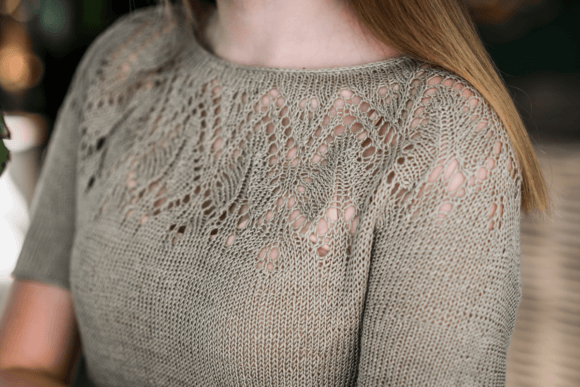
The Etera Top is more than a garment—it’s a well-structured system for intentional making. Designed to work “seamlessly from the top down,” it embeds thoughtful process design into every stitch: the circular yoke’s lace motif repeats in side panels, guiding shape development with visual and structural continuity. This isn’t just aesthetic harmony—it’s workflow logic translated into fiber. For makers who treat knitting as both craft and method—whether developing a capsule wardrobe, teaching garment construction, launching a small-batch line, or refining personal technique—the Etera Top serves as a reliable anchor point across skill levels, ages, and intentions.
How Etera Top Fits Into Real Crafting Workflows
Unlike patterns that prioritize speed over adaptability, Etera Top assumes you’ll need to adjust—not as an afterthought, but as part of the plan. Its two shaping options (moderate A-line to the hipline vs. pronounced A-line) aren’t alternatives; they’re parallel paths built into the same framework. You choose early, yes—but the instructions accommodate that decision without backtracking, re-calculation, or guesswork. That means less time auditing charts and more time evaluating fit, drape, and yarn behavior as you go.
This matters most when knitting intersects with broader goals: a teacher preparing class samples needs consistent sizing across age groups; a small business owner prototyping for a linen-focused collection requires predictable yardage and repeatable shaping; a parent making for multiple children benefits from one pattern that scales cleanly from 12 months to 14 years—and continues seamlessly into adult sizes. The Etera Top supports those workflows because its structure anticipates variation, not exception.
Integration Before, During, and After the Project
Before casting on: Gauge becomes your first calibration step—not just for stitch count, but for intention. At 22 sts and 36 rows over 4" in stockinette on 2.75 mm needles, the fabric must balance drape and definition. Linen’s stiffness means swatching isn’t optional; it’s your quality control checkpoint. Use the recommended yarns—Quince & Co. Sparrow (held single) or SIŪLAS Lithuanian Linen (held double)—not just for fiber integrity, but for consistency across batches. If substituting, match both gauge *and* yardage per 100 g, especially when planning multi-size production.
During knitting: The top-down construction eliminates seaming but demands active tracking. Stitch markers separate yoke repeats from side panels, and row-by-row instructions prevent ambiguity at lace increases or shaping transitions. Because sleeve and body length are fully customizable, you’re never locked into arbitrary measurements—you decide based on wear context (e.g., cropped for layering, longer for coverage, tighter sleeves for mobility). Keep a spare circular needle or stitch holder ready for sleeve stitches; having them prepped avoids mid-process pauses.
After finishing: Blocking isn’t a final flourish—it’s data capture. Linen blooms significantly. Measuring post-block reveals whether your chosen shaping option delivered the intended silhouette. Compare against schematic measurements *after* blocking, not before. This informs future adjustments: if the moderate A-line reads fuller than expected on a particular yarn, you’ll know to shift to the pronounced version—or modify increase frequency—next time. That feedback loop turns each make into calibrated learning.
Practical Implementation Across Contexts
For educators and workshop leaders, Etera Top works as a scaffolded curriculum tool. Start students on the yoke alone to master lace repeats and short-row neck shaping. Then introduce side-panel increases as a lesson in directional shaping. Finally, add sleeves and length customization to demonstrate how modular decisions compound into cohesive outcomes. The pattern’s clarity reduces cognitive load—freeing mental space for technique refinement rather than decoding.
For small business owners and indie designers, the size range (kids 12 mos–14 yrs + adults 32–62) supports inventory efficiency. Produce sample garments in key sizes—say, 4 yrs, 8 yrs, and 38—then use those as fitting references for custom orders. Because all versions share the same yoke geometry and panel logic, grading remains intuitive. No need for external software: the row-by-row instructions scale proportionally, preserving lace alignment and shaping rhythm.
For hobbyists managing time across commitments, the top-down approach offers natural pause points. Finish the yoke? You’ve got a wearable crop. Add 3 inches to the body? It’s now a tunic. Reach your desired sleeve length? Bind off and block. There’s no “almost done” frustration—only incremental completion.
Compatibility and Consistency Considerations
- Yarn substitution: Stick to 100% linen or high-linen blends with similar twist and yardage. Cotton or wool will alter drape, tension, and blocking behavior—potentially disrupting the A-line progression.
- Needle flexibility: While 2.75 mm and 2.5 mm are specified, your actual gauge determines what works. Swatch aggressively—even half a millimeter difference changes fabric density enough to affect shaping accuracy.
- Organization: Use removable stitch markers for yoke repeats, locking ones for side-panel boundaries, and a contrasting scrap of yarn for the “start of round.” Keep a simple log: date, size, yarn lot, needle size, blocked measurements. Over time, this builds your personal reference library.
- Efficiency tip: When working multiple sizes, chart only the yoke repeat once. Side-panel increases follow the same math across all sizes—just adjust starting stitch counts. That saves hours across a season of making.
Long-Term Use and Quality Control
Linen improves with wear, but only if the foundation is sound. The Etera Top’s clean increases, even lace distribution, and balanced shaping prevent distortion over time. Pay attention to underarm reinforcement—especially for adult sizes or frequent wear. A few extra rounds of waste yarn or a reinforced bind-off there extends garment life significantly.
Equally important is documentation. Save your notes alongside the printed pattern: where you modified increase frequency, how much ease you added at the bust, whether you adjusted sleeve cap depth for mobility. These aren’t deviations—they’re your personal implementation layer. Future projects won’t start from zero; they’ll start from your proven refinements.
Ultimately, the Etera Top succeeds because it respects the maker’s agency. It doesn’t ask you to conform to rigid rules—it gives you precise tools, then steps back. Whether you’re knitting for function, expression, income, or quiet focus, it meets you where you are and supports how you actually work: iteratively, intentionally, and without unnecessary friction.