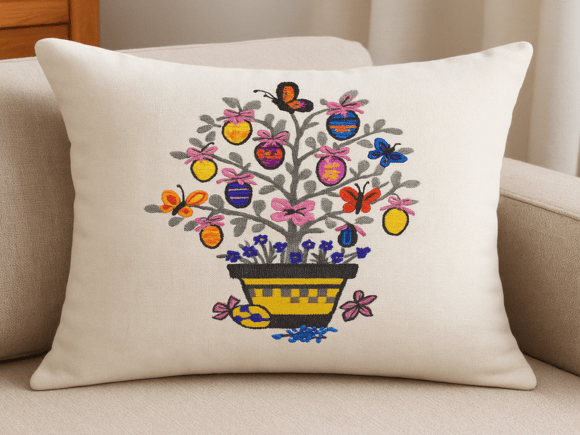
Easter Egg Tree Embroidery Design
There’s something quietly joyful about an Easter egg tree — a tradition rooted in German folklore, where bare branches become canvases for painted or decorated eggs, symbolizing renewal and hope. Today, that spirit lives on in the Easter Egg Tree Embroidery Design, a versatile, machine-ready motif that blends seasonal symbolism with modern craft practicality. It’s not just decorative; it’s a functional creative tool — designed to be stitched, adapted, scaled, and reimagined across textiles, home goods, and small-batch products.
What Makes This Design Stand Out?
Unlike generic Easter motifs, this design centers a cohesive, balanced composition: a slender, graceful tree branch adorned with hand-drawn-style eggs in soft pastels and bold primaries, interspersed with fluttering butterflies and blooming florals — daffodils, cherry blossoms, and tiny violets. The digitization is clean and stitch-efficient, with thoughtful underlay and satin-stitch balance so it holds up well on medium-weight cotton, linen, and even lightweight denim.
It comes pre-organized in multiple embroidery file formats (.dst, .pes, .jef, .exp, .vp3, .xxx) — meaning you’re not locked into one brand or machine. Whether you're using a Brother SE600, Janome Horizon Memory Craft, or Bernina 790, the files load cleanly and scale predictably. No re-digitizing. No guesswork.
Creative Applications Beyond the Pillow
The Easter pillow example — with its cheerful eggs, delicate butterflies, and vibrant blooms — is just the starting point. Here’s how makers across disciplines are putting this design to work:
- Home textiles: Stitch it onto linen napkins (scaled to 3.5"), tea towels (centered at 5"), or quilt blocks (as part of a seasonal sampler). Use variegated thread for subtle tonal shifts in the flower petals.
- Wearables: Resize the design to 2.2" and apply it to the chest pocket of a child’s overalls, or mirror it across the back yoke of a reversible smock. Pair with coordinating floss colors — mint green thread for stems, butter yellow for egg whites — to keep cohesion across pieces.
- Small business products: A boutique gift shop uses the design on organic-cotton drawstring bags (4.5" wide), then pairs them with locally dyed eggs and wildflower seed packets. It reads as handmade but ships consistently.
- Educational settings: Art teachers print the outline as a coloring sheet, then have students embroider one element (e.g., just the butterflies) by hand — building confidence before moving to machine work.
Adapting for Different Goals and Audiences
Your goals shape how you use the design — and that’s where intentionality matters. A blogger documenting seasonal crafts might stitch three versions side-by-side: one in monochrome ecru thread on oat-colored linen (for minimalist appeal), one with metallic gold accents on navy fabric (for editorial contrast), and one fully saturated on white canvas (for social media clarity). Each version serves a distinct visual purpose — and each tells a different story about what “spring charm” means in context.
For educators or workshop leaders, consider separating the design into layers: eggs only, butterflies only, flowers only. Export each as its own file. That way, participants can choose their focus — reducing cognitive load while still engaging with the full theme. It also encourages variation without requiring new digitizing.
Entrepreneurs selling digital files alongside physical goods often bundle the Easter Egg Tree Embroidery Design with a printable stitching guide (thread chart, stabilizer recommendations, troubleshooting tips) and a simple SVG version for Cricut users who want to cut egg-shaped appliqué pieces. That cross-format thinking expands reach without diluting quality.
Staying Consistent Without Sacrificing Originality
Consistency doesn’t mean repetition — it means thoughtful repetition. If you’re building a seasonal product line, use the same base tree layout across Easter, Mother’s Day (swap eggs for teacups and add lace motifs), and early summer (replace eggs with strawberries and bees), keeping trunk placement and branch angle identical. That visual throughline helps customers recognize your style instantly — even when elements change.
For originality, lean into *how* you interpret the design — not whether you alter it. Try stitching the eggs with French knots instead of satin fill. Or use water-soluble topping to float delicate butterfly wings above the fabric surface. Swap out the default floral cluster for herbs like lavender or rosemary sprigs — tying the motif to local gardening culture or wellness themes.
Practical Tips for Best Results
Start with the right foundation. Use tear-away stabilizer for stable wovens (like quilting cotton), and cut-away for knits or stretchy fabrics. For textured surfaces like burlap or linen-weave canvas, add a light layer of water-soluble topping — it keeps stitches from sinking into the weave and gives cleaner definition to fine details like butterfly antennae.
Test stitch on scrap fabric first — especially if you’re combining this design with others. Check alignment when nesting it near text (e.g., “Spring Has Sprung”) or borders. The tree’s natural asymmetry means it works best with organic, non-grid-based layouts — avoid forcing it into rigid symmetry unless that’s your deliberate aesthetic choice.
When photographing finished pieces, shoot in natural north-light — no flash — and include one detail shot of the egg textures and another showing scale (e.g., the pillow beside a mug or a pair of garden gloves). That builds trust and helps viewers imagine the piece in their own space.
Why This Design Fits Real Creative Workflows
This isn’t a “one-and-done” decoration. It’s built for iteration — for the quilter refining a series, the educator scaffolding skill-building, the small-batch maker testing color stories, or the content creator developing a seasonal visual language. Its strength lies in its clarity: every element reads at a glance, yet each invites deeper engagement — whether you’re choosing thread weight, deciding which eggs to highlight, or planning how the butterflies will “fly” across a curtain panel.
And because it’s rooted in a meaningful tradition — the egg tree as a symbol of growth, patience, and quiet celebration — it carries emotional resonance without needing explanation. You don’t have to justify why it feels uplifting. It just does.
So whether you’re stitching your first Easter pillow or launching a spring-themed product drop, let the Easter Egg Tree Embroidery Design serve as both anchor and spark: grounded in craft tradition, flexible enough for your voice, and detailed enough to reward attention — stitch by intentional stitch.